A summary of South Carolina’s collaboration, agreement, filing, supervision, prescribing, and specialty rules for NPs and the physicians who collaborate with them.

Collaborating Physician Required? Yes

Physician Involvement: Low

Agreement Name: Practice agreement

On-Site Requirements: None

Chart Review: None
Controlled Substances: Allowed if listed in the practice agreement (Schedule II narcotics limited to a 5-day supply and require the physician’s written agreement for any further prescription; Schedule II non-narcotics limited to a 30-day supply) and federal DEA

Reduced Supervision / Transition Requirements: None
South Carolina NP Collaboration Requirements Summary
South Carolina nurse practitioners must practice under a written practice agreement with a collaborating physician. South Carolina is a collaborative-practice state, but the physician’s day-to-day involvement is light: the physician must be reachable for consultation, yet the state requires no on-site presence, no set meeting schedule, and no chart review. There is no pathway to independent practice.
Source: S.C. Code Ann. § 40-33-34
Type of Collaborative Relationship
South Carolina NPs perform medical acts under a written practice agreement with a collaborating physician who must be readily available but is not required to be on-site. One physician may collaborate with the equivalent of up to six full-time advanced practice providers (NPs, certified nurse-midwives, clinical nurse specialists, and physician assistants combined), and the board may approve exceptions. The physician must hold an active, unrestricted South Carolina medical license and actively practice within the state. There is no path to reduced supervision or independent practice.
Source: S.C. Code Ann. § 40-47-195(D)(1)
What is an NP’s scope of practice in South Carolina?
South Carolina NPs may perform medical acts — including prescribing — within the terms of a written practice agreement with a collaborating physician. The specific conditions, treatments, and drugs an NP may handle are defined in that agreement rather than by a broad statutory formulary.
Do NPs need a collaborating physician in South Carolina?
Yes. South Carolina NPs must perform medical acts under a written practice agreement with a collaborating physician; there is no independent-practice option.
Can NPs practice independently in South Carolina?
No. South Carolina has no independent- or reduced-supervision pathway; NPs must always work under a practice agreement with a collaborating physician.
How many NPs can a physician supervise in South Carolina?
Up to the equivalent of six full-time advanced practice providers at one time, counting NPs, certified nurse-midwives, clinical nurse specialists, and physician assistants together. The board may approve an exception on application if patient safety and quality of care are maintained.
Who can be a collaborating physician in South Carolina?
A physician who holds an active, unrestricted, permanent South Carolina medical license, actively practices within the state, and has training or experience in all tasks delegated to the NP. The physician must not agree to a task outside their own usual practice, training, or experience unless the board approves an exception.
Are there proximity or in-person requirements in South Carolina?
No in-person or proximity requirement applies, but the physician must actively practice medicine within the geographic boundaries of South Carolina. The physician needs only to be reachable in person, by phone, or by other electronic means for consultation — the state sets no on-site rule.
Collaboration Agreement Requirements
South Carolina’s written agreement is called a practice agreement, and it must spell out the medical aspects of the NP’s care, including prescribing. Required content includes the name, address, and South Carolina license number of both the NP and physician; the nature and locations of the practice; the effective and last-amendment dates; how physician consultation and backup are provided; the medical conditions, treatments, and drug therapies the NP may initiate, continue, or modify; and the situations requiring referral to the physician. Prescribing authority must be specific — drugs must be listed by category rather than by giving blanket authorization for an entire schedule. Both the NP and physician sign it, and it must be reviewed at least annually. The state does not provide a template.
Source: S.C. Code Ann. § 40-33-34(D)(1)
What must be included in an NP collaborative agreement in South Carolina?
The medical aspects of care and prescribing the NP may perform, plus identifying details. That includes both parties’ names, addresses, and South Carolina license numbers; practice nature and locations; effective and amendment dates; how physician consultation and backup are arranged; the conditions, treatments, and drug therapies the NP may initiate, continue, or modify; and the situations requiring referral to the physician. Authorized drugs must be listed by category, not by blanket schedule.
What is the collaborative agreement called in South Carolina?
It is called a practice agreement — South Carolina’s term for the written collaborative agreement between an NP and a collaborating physician.
Who has to sign the collaborative agreement in South Carolina?
Both the NP and the collaborating physician. The original agreement and any amendments must be dated and signed by both and made available to the board within 72 hours of a request.
How often must the agreement be reviewed or renewed in South Carolina?
At least annually. The practice agreement and any amendments must be reviewed, dated, and signed by both the NP and physician at least once a year.
Is a backup physician required in South Carolina?
Not a specific backup physician, but the agreement must describe how backup consultation is provided when the collaborating physician is unavailable. In other words, a process for backup is required even though naming a covering physician is not.
Board Filing Requirements
South Carolina does not require NPs to file the practice agreement with the board. NPs generally may practice once their agreement is in place, except when they are submitting it as part of a prescriptive-authority application. NPs must notify the board within 15 business days of any change in practice setting or collaborating physician, and within 15 business days when they discontinue practice. There are no recurring filing requirements.
Source: S.C. Code Ann. § 40-33-34(D)(4)
Do you have to file the collaborative agreement with the board in South Carolina?
No. South Carolina does not require the practice agreement to be filed with the board, though it must be produced for the board within 72 hours if requested.
Can an NP start practicing as soon as they file in South Carolina?
Yes, in most cases, an NP may practice once the agreement is in place — unless the agreement is being submitted as part of a prescriptive-authority application, in which case that application must be processed first.
What are the termination and notice requirements in South Carolina?
NPs must notify the board within 15 business days of a change in practice setting or collaborating physician, and within 15 business days of discontinuing practice.
Collaboration Compliance
South Carolina keeps ongoing compliance light: there is no required meeting schedule, no chart-review requirement, and no co-signature requirement. The collaborating physician must simply be readily available — reachable in person, by phone, or by other electronic means — to provide consultation and advice. The one heightened obligation involves controlled substances: any refill of a Schedule II narcotic prescription requires the physician’s written agreement. The board may audit a practice agreement at least once every two years.
Source: S.C. Code Ann. § 40-33-20(52)
How many charts must a collaborating physician review in South Carolina?
None. South Carolina sets no chart-review requirement and no requirement to co-sign charts.
How often must an NP and collaborating physician meet in South Carolina?
There is no required meeting schedule. South Carolina sets no meeting cadence; the physician need only remain readily available for consultation by phone, in person, or other electronic means.
How long must collaboration records be kept in South Carolina?
South Carolina sets no specific retention period for collaboration records, but the practice agreement must be produced for the board within 72 hours of a request, and the board may audit it at least every two years.
Prescribing Rules
South Carolina NPs may prescribe — including controlled substances — once they obtain prescriptive authority and the specific drugs are listed in their practice agreement. Controlled substances must be authorized under both the practice agreement and federal law: Schedule II nonnarcotic prescriptions are limited to a 30-day supply, and Schedule II narcotic prescriptions are limited to a 5-day supply with no further prescription written without the physician’s written agreement (except for hospice, palliative-care, and long-term-care patients). Prescription forms must include the name, address, and phone number of both the NP and the physician.
Source: S.C. Code Ann. § 40-33-34(F)(1)
Can an NP prescribe controlled substances in South Carolina?
Yes, once the NP has prescriptive authority and the specific controlled substances are listed in the practice agreement, consistent with federal scheduling law. Schedule II narcotics additionally require the physician’s written agreement for any prescription beyond the initial 5-day supply.
Can an NP prescribe Schedule II drugs in South Carolina?
Yes, if listed in the practice agreement, but with limits: Schedule II nonnarcotics are capped at a 30-day supply, and Schedule II narcotics are capped at a 5-day supply, with any further Schedule II narcotic prescription requiring the physician’s written agreement (except for hospice, palliative-care, or long-term-care patients).
What schedule drugs can an NP prescribe in South Carolina?
NPs with prescriptive authority may prescribe the drugs listed in their practice agreement, including controlled substances in Schedules II through V as authorized by state and federal law. Authorized drugs must be listed specifically by category rather than by blanket authorization of an entire schedule.
Does an NP need a DEA license in South Carolina?
Yes, a federal DEA registration is required for an NP to prescribe controlled substances.
Can an NP prescribe independently (without physician sign-off) in South Carolina?
No. NPs prescribe only what is authorized in their practice agreement, and any Schedule II narcotic prescription beyond the initial 5-day supply requires the collaborating physician’s written agreement.
Specialty & Telehealth Requirements
South Carolina sets no specialty-specific or telehealth-specific collaboration requirements for NPs.
Source: S.C. Code Ann. § 40-47-195(D)(1)(e)
Are there telehealth or telemedicine requirements for NPs in South Carolina?
No — South Carolina sets no telehealth-specific collaboration requirements for NPs. Telehealth practice still follows the general practice-agreement, availability, and prescribing rules.
Are there specialty-specific requirements for NPs in South Carolina?
No — South Carolina sets no specialty-specific collaboration requirements for NPs.
How do you verify a collaborating physician’s license in South Carolina?
Confirm the physician holds an active, unrestricted, permanent license with the South Carolina Board of Medical Examiners and is actively practicing within the state. The board’s public license-lookup is the source of record for verifying that status.
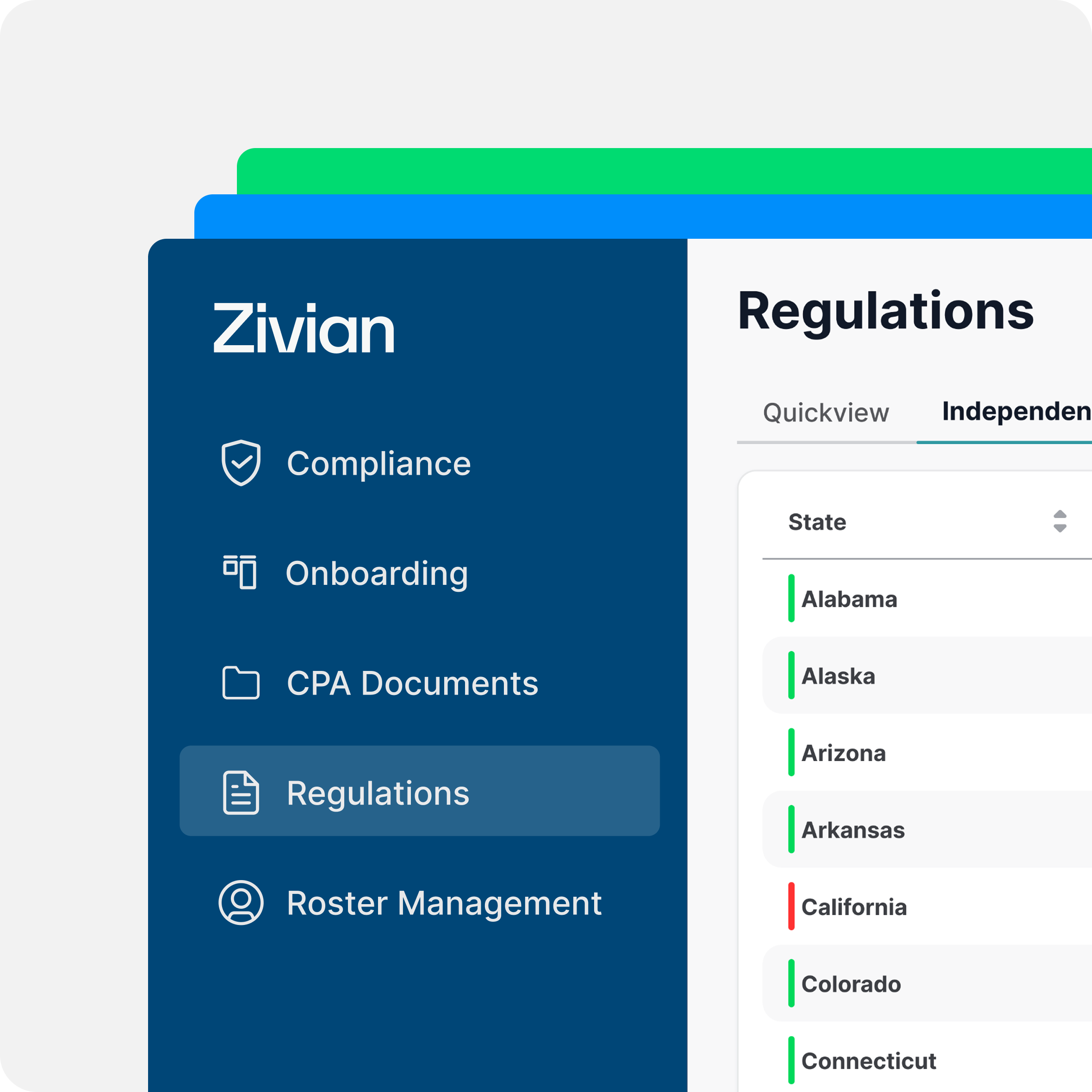
Zivian gives you complete, real-time regulatory intelligence for NPs and PAs. Get step-by-step board-filing workflows, compliance and quality assurance tracking, and automatic alerts across all 50 states.