A summary of Alabama’s collaboration, agreement, filing, supervision, prescribing, and specialty rules for NPs and the physicians who collaborate with them.

Collaborating Physician Required? Yes

Physician Involvement: High
Agreement Name: Standard protocol

On-Site Requirements: At least 10% of NP hours until 2 yrs / 4,000 hours; telehealth-only exempt

Chart Review: Quarterly QA incl. a meaningful record sample (no fixed count)

Controlled Substances: Allowed with QACSC (III–V) + LPSP (II) + federal DEA

Reduced Supervision / Transition Requirements: 2 years / 4,000 hours
Alabama NP Collaboration Requirements Summary
Alabama requires nurse practitioners (CRNPs) to practice under a written collaborative practice agreement (a “standard protocol”) with a collaborating physician. Alabama is a collaborative-practice state: physician involvement is high, there is no full independent-practice pathway, and after two years or 4,000 hours of collaborative experience the physician’s on-site presence requirement eases. This page summarizes Alabama’s collaboration, agreement, filing, supervision, prescribing, and specialty rules for NPs and the physicians who collaborate with them.
Source: Ala. Admin. Code r. 610-X-5-.04, -.05, -.09
Type of Collaborative Relationship
Alabama NPs are required to have a collaborating physician who stays actively involved in the practice. Alabama law does not automatically make the collaborating physician legally responsible for the NP’s care.
One physician may collaborate with up to nine full-time-equivalent (FTE) advanced practitioners at a time, counting NPs, certified nurse midwives, and physician assistants together.
To serve as a collaborating physician, the doctor must have practiced for at least three years — or one year if board-certified by an ABMS or AOA specialty board, or one year if the practice is limited to a qualifying acute-care hospital. Until an NP completes two years or 4,000 hours of collaborative practice, the physician must be physically present for at least 10% of the NP’s scheduled hours, and remote sites must be visited at least twice a year. Telehealth-only collaborations have no in-person presence requirement.
Source: Ala. Admin. Code r. 610-X-5-.04, -.05, -.09
What is an NP’s scope of practice in Alabama?
Alabama CRNPs may assess, diagnose, treat, and prescribe within a board-approved formulary, but only under a written standard protocol with a collaborating physician, never independently.
Do NPs need a collaborating physician in Alabama?
Yes. Alabama NPs must practice under a written standard protocol with a collaborating physician; there is no independent-practice option.
Can NPs practice independently in Alabama?
No. Alabama has no independent-practice pathway; NPs must always work under a standard protocol with a collaborating physician, though the physician’s on-site presence requirement eases after two years or 4,000 hours.
How many NPs can one physician collaborate with in Alabama?
Up to nine FTE combined (NPs, nurse midwives, and PAs). Collaborating with more than four FTE NPs triggers monthly quality-assurance review with each new NP for the first six months.
Who can be a collaborating physician in Alabama?
A physician with three years of practice, or one year plus ABMS/AOA board certification, or one year if the practice is limited to a qualifying acute-care hospital.
Are there proximity requirements in Alabama?
Yes, until the NP is experienced. The physician must be on-site for at least 10% of the NP’s hours until the NP reaches two years / 4,000 hours; telehealth-only collaborations are exempt.
Collaboration Agreement Requirements
Alabama’s agreement is called a standard protocol. It must identify every site where the NP will practice and the physician’s principal site; include a formulary of the drugs, devices, tests, and procedures the NP may use; set out a plan for emergency services and a process for referring patients; and include a quality-assurance plan with defined outcome measures and review of a meaningful sample of medical records. Both the NP and the collaborating physician must sign it, and Alabama publishes protocol and quality-assurance examples. A copy must be kept at each practice site and on file with both the Board of Nursing and the Board of Medical Examiners. The protocol itself does not require periodic updating, but the collaborating physician must certify annually that the collaboration is still active. A back-up (covering) physician is not required in the protocol, but any covering physician must be pre-approved by the Board of Medical Examiners.
Source: Ala. Admin. Code r. 610-X-5-.09(8); Ala. Code § 34-21-81(13)
What must an Alabama NP collaborative agreement include?
Practice sites, the physician’s principal site, a drug formulary, an emergency-services plan, a referral process, and a quality-assurance plan with defined outcome measures and record review.
What is the collaborative agreement called in Alabama?
It is called a standard protocol — Alabama’s term for the written collaborative practice agreement between an NP and a collaborating physician.
Who signs the collaborative agreement in Alabama?
Both the NP and the collaborating physician.
How often must the agreement be reviewed or renewed in Alabama?
The protocol itself does not require periodic updating, but the collaborating physician must certify annually that the collaboration is still active, and any change to the collaboration requires re-submitting the updated protocol.
Does Alabama provide a collaborative agreement template?
Yes. Alabama publishes protocol examples for multiple specialty and prescribing scenarios, plus quality-assurance plan examples.
Is a back-up physician required in Alabama?
Not in the protocol itself, but any covering physician must be pre-approved by the Board of Medical Examiners.
Board Filing Requirements
Alabama requires filing before practice begins. The NP applies online and submits the standard protocol as part of the application; the collaborating physician separately files a collaboration commencement through the Board of Medical Examiners portal. NPs cannot begin full practice the moment they file — temporary approval is typically issued within days by email, but full approval generally takes about 45–60 days because the boards review applications monthly. If the collaboration is later changed, the updated protocol must be re-submitted. When a collaboration ends, the physician must notify the Medical Board within 14 days; termination of a covering physician must be reported within 10 days.
Source: Ala. Admin. Code r. 610-X-5-.06, -.09
Do you have to file the collaborative agreement with the board in Alabama?
Yes. The NP applies online with the protocol, and the physician files a collaboration commencement through the Board of Medical Examiners.
Can an Alabama NP practice as soon as they file?
No. Temporary approval usually arrives within days by email, but full approval typically takes about 45–60 days due to monthly board review.
What are the termination-notice requirements in Alabama?
The physician must notify the Medical Board within 14 days of ending a collaboration, and within 10 days for a covering-physician termination.
Collaboration Compliance
Alabama’s ongoing obligations center on quarterly quality assurance. The collaborating physician must complete a documented QA review with each NP at least quarterly and must be readily available — by phone or other telecommunication — for consultation and referral, including at remote sites. Alabama does not set a fixed number of charts to review; instead, each quarterly QA must include review of a meaningful sample of medical records plus all adverse outcomes. QA documentation must be kept for the life of the collaboration and for three years after it ends. Alabama imposes no additional supervision requirement specifically for controlled substances beyond the standard protocol.
Source: Ala. Admin. Code r. 610-X-5-.09(5), (8)
How often must an Alabama NP and physician meet?
At least quarterly, through a documented quality-assurance review.
How many charts must be reviewed in Alabama?
There is no fixed number. Each quarterly QA must include a meaningful sample of medical records plus all adverse outcomes.
How long must collaboration records be kept in Alabama?
For the life of the collaboration plus three years after it ends.
Prescribing Rules
Alabama NPs may prescribe legend (prescription) drugs that appear on the board-adopted formulary and are authorized in their protocol; prescribing beyond the standard is limited to what the protocol specifically allows. To prescribe controlled substances, an Alabama NP must hold two additional state credentials — a Qualified Alabama Controlled Substances Certificate (QACSC) for Schedules III–V and a Limited Purpose Schedule II Permit (LPSP) for Schedule II — in addition to a federal DEA registration. Prescriptions must use a format that identifies the collaborating physician (name, site address, phone), the NP and their license number, and the required product-selection and dispensing lines.
Source: Ala. Admin. Code r. 610-X-5-.12
Can Alabama NPs prescribe controlled substances?
Yes, with two state credentials — a QACSC for Schedules III–V and an LPSP for Schedule II — plus a federal DEA registration.
Can Alabama NPs prescribe Schedule II drugs?
Yes, but only with a Limited Purpose Schedule II Permit (LPSP), in addition to a federal DEA registration.
What schedule drugs can an Alabama NP prescribe?
Alabama NPs may prescribe legend (non-controlled) drugs on the board-approved formulary, controlled substances in Schedules III–V with a QACSC, and Schedule II with an LPSP — each alongside a federal DEA registration.
Do Alabama NPs need a DEA license?
Yes, a federal DEA registration is required in addition to the two Alabama controlled-substance credentials.
Can Alabama NPs prescribe independently?
No. NPs prescribe within the board-adopted formulary and the drugs, dosages, and refills authorized in their protocol.
Specialty & Telehealth Requirements
Alabama distinguishes clinical nurse specialists (CNSs) from CRNPs and CNMs: a CNS may not perform delegated medical acts, may not perform the functions of an NP or nurse midwife, and may not prescribe drugs of any type. Alabama sets no telehealth-specific collaboration requirements — and telehealth-only collaborations are exempt from the in-person presence rule — and Alabama’s rules don’t automatically make the collaborating physician legally responsible for the NP’s care.
Source: Ala. Code § 34-21-81(2)(d)
Are there specialty-specific NP rules in Alabama?
Yes, for clinical nurse specialists. A CNS may not perform delegated medical acts, may not perform NP or nurse-midwife functions, and may not prescribe.
Are there telehealth-specific requirements in Alabama?
No. Alabama sets no telehealth-specific collaboration rules, and telehealth-only collaborations are exempt from the on-site presence requirement.
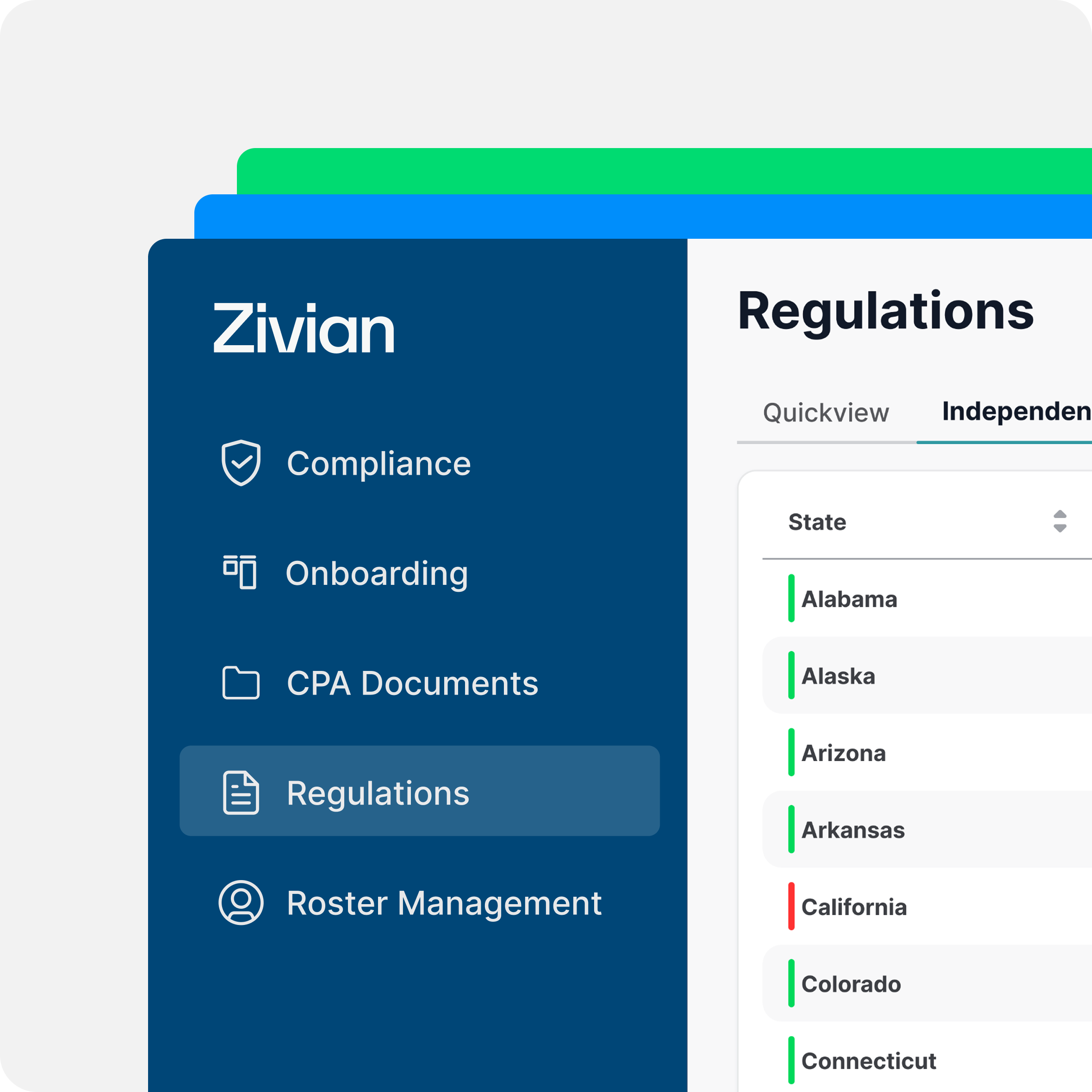
Zivian gives you complete, real-time regulatory intelligence for NPs and PAs. Get step-by-step board-filing workflows, compliance and quality assurance tracking, and automatic alerts across all 50 states.