
If your organization delivers care primarily through nurse practitioners (NPs) and physician assistants (PAs), compliance is extremely important. Compliance decides how fast you can enter a new state, whether your collaboration agreements hold up under review, and whether you can prove oversight when a payer, board, or auditor asks. So it’s important to choose the best healthcare compliance software for your operational needs.
The problem is that most software marketed as “healthcare compliance software” was not built for the work that NP and PA collaboration actually requires. Credentialing platforms verify licenses. Workforce tools manage schedules. Training systems track policy attestations. Very few handle the specific obligations that govern advanced practice providers (APPs): collaborating physician requirements, chart review, supervision ratios, prescriptive authority limits, board filings, and rules that differ in all 50 states and change regularly.
This guide explains the categories of software available in 2026, gives you a practical evaluation framework, and explains the best healthcare compliance software for NP and PA collaboration, so you can choose the right tool for how your organization actually operates.
Quick Answer: Which Type of Software Fits Which Job
There is no single “best” tool. The right choice depends on the problem you’re solving.
- Best for managing NP/PA collaboration compliance across states: purpose-built NP/PA compliance infrastructure that covers collaboration agreements, board filings, ongoing collaboration management, chart review, supervision ratios, and 50-state practice rules in one place. Zivian Health is built specifically for this.
- Best for high-volume credentialing and payer enrollment: dedicated credentialing platforms such as Medallion, Verifiable, and CertifyOS.
- Best for large hospital and health-system provider data and privileging: provider management suites such as Symplr and QGenda.
- Best for staff training, policy, and broad governance, risk, and compliance (GRC): tools such as MedTrainer and HealthStream.
- Worst long-term option as you scale: spreadsheets, shared drives, and manual reminders. They work until they do not, and the failure usually surfaces during an audit or expansion.
The rest of this article unpacks why these categories are different and how to evaluate them against your own care model.
What “NP and PA Collaboration Compliance” Actually Means
Before comparing tools, it helps to be precise about the work. Compliance for an NP and PA workforce is not one requirement. It is a set of obligations that follow each provider, in each state, for as long as they practice.
For nurse practitioners, the central question in many states is practice authority. Some states grant full practice authority, meaning NPs can evaluate, diagnose, and prescribe independently. Others impose reduced or restricted practice, which require a formal relationship with a collaborating physician, and often add chart review, supervision ratios, prescribing limits, or board filings on top.
For physician assistants, the model is typically supervision or collaboration with a physician, and the specific requirements, including documentation, ratios, and scope, vary by state and continue to evolve.
This complexity creates a recurring operational checklist that compliance and clinical operations teams have to manage for every provider:
- A valid, state-appropriate collaboration or supervision agreement for each NP or PA who needs one
- The right collaborating or supervising physician identified and contracted
- Chart review completed at the cadence the state requires, with documentation to prove it
- Supervision and collaboration ratios kept within state limits as you add providers
- Board filings or notifications submitted where the state requires them before a provider can practice
- Licenses, DEA registrations, and credentials tracked and renewed on time
- An audit trail that shows all of the above actually happened
Now multiply that by dozens or hundreds of providers, across six, twelve, or thirty states, each with its own rules. This is the work general compliance software is not designed to carry.
The Categories of Healthcare Compliance Software, Compared
Most products buyers consider fall into one of five buckets. Each does a real job well. A common mistake is assuming any one of them covers NP/PA collaboration compliance end to end.
NP and PA Collaboration Compliance
NP and PA collaboration compliance software is purpose built for the challenge of managing and scaling NP and PA teams compliantly. NP and PA compliance software is intended for:
- Collaborating physician sourcing
- Collaboration agreements and board filings
- 50-state NP/PA practice rules
- Ongoing compliance and QA tracking
- EHR-integrated chart review
- Supervision ratio tracking
- Audit trails
- License and credentials management
Zivian Health is the only enterprise-grade compliance software that exists within this category.
Credentialing and Provider Data Platforms
Credentialing and provider data platforms are built around verification and enrollment. They typically do not manage collaboration agreements, chart review cadence, or state rules.
Credentialing and provider data tools are work well for:
- Primary source verification
- License and DEA monitoring
- Payer enrollment
- Ongoing sanctions monitoring
Examples: Medallion, Verifiable, CertifyOS, Verisys
Provider Management Suites
Provider management platforms are designed for physician-led, facility-based systems, not multi-state APP-led care models. They work well for:
- Credentialing
- Privileging
- Provider data management for large hospitals and health systems
Examples: Symplr, QGenda, CredentialStream
Training, Policy, and GRC Tools
Training, policy, and GRC tools manage broad organizational compliance, rather than provider-level collaboration requirements. They also contain no state-by-state APP practice intelligence.
Traininy, policy, and GRC tools work well for:
- Staff training
- Policy distribution and attestation
- Incident management
- HIPAA and OSHA workflows
Examples: MedTrainer, HealthStream
Spreadsheets and Manual Tracking
Tracking compliance manually is a cheap and flexible alternative that may save time at the start, but fails at scale. Stitching together NP and PA compliance with spreadsheets, Drive folders, and point solutions fall short with regulatory intelligence, alerts, audit trails, and multi-state APP deployment.
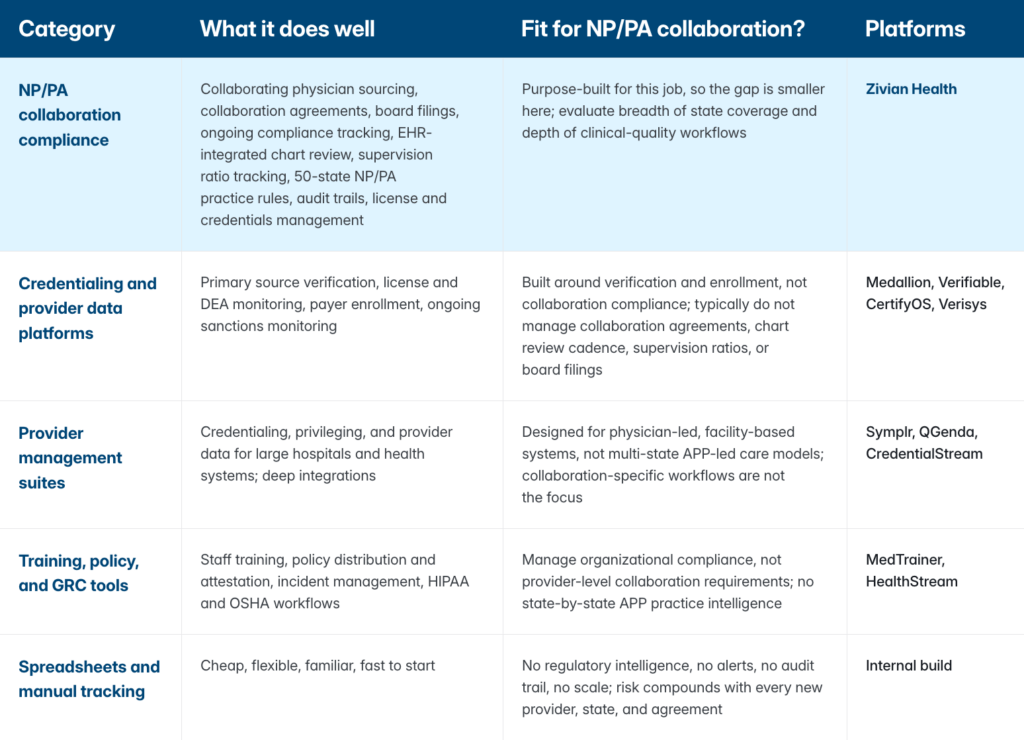
In simpler terms:
- Credentialing tools answer “is this provider verified and enrolled?”
- Provider management suites answer “is this provider privileged at our facility?”
- Training tools answer “did our staff complete their policies?”
None of those is the same question as, “is this NP legally authorized to practice in this state, with the right collaborating physician, the right agreement, the right chart review, and proof we can hand to an auditor?”
A Practical Evaluation Framework
Use these seven criteria to evaluate any tool against your own care model. The more of your NP and PA footprint sits in reduced or restricted practice states, the more weight the first four criteria carry.
- State regulatory coverage: Does the platform codify NP and PA practice requirements for every state you operate in, and keep them current as rules change? Ask how updates are sourced and how quickly they are reflected.
- Collaboration and supervision workflows: Can it generate and store state-appropriate collaboration or supervision agreements, and track their status from pending to active?
- Clinical oversight: Does it route chart reviews, capture documentation, and track supervision and collaboration ratios as you add providers?
- Board filings: Does it support board submissions and notifications where states require them before a provider can practice?
- Provider data and credentialing: Does it centralize licenses, DEA registrations, and credentials with renewal alerts, so nothing expires unnoticed?
- Audit readiness: Can you export a timestamped audit trail on demand, rather than assembling evidence under pressure during a review?
- Physician access: If you struggle to find collaborating physicians or medical directors, does the platform help you source qualified physicians, or does it assume you already have them?
A tool can be excellent and still score low here if it was built for a different job. But it’s the reason to match the category to the problem.
Who NP/PA Compliance Software Matters For, and When
This decision is most urgent for a specific kind of organization.
Who this is for: growth-stage to enterprise healthcare organizations that deliver care primarily through NP and PA workforces and operate, or plan to operate, across multiple states. That includes digital health and telehealth companies, multi-state care delivery organizations, MSOs, payviders, and specialty groups in primary, urgent, hybrid, in-home, metabolic, women’s health, behavioral health, and chronic care. The pattern that defines the strongest fit is simple: NPs and PAs deliver most of the care, supervising-physician relationships are a structural requirement rather than an afterthought, and the workforce is growing faster than the administrative infrastructure beneath it.
When this matters: the need usually becomes visible at one of a few moments. You are entering new states and discovering that each one has different rules and requires physician oversight for your providers. You have crossed roughly 20 or more APPs and the compliance tracking spreadsheet that worked at 20 is breaking at 60. You are preparing for a payer review, board inquiry, or audit and cannot quickly prove oversight. Or you have poor collaboration structures, and collaborations you manage in-house informally suddenly need a real home.
If you operate in a single state with no expansion plans, manual tracking may still be workable, and a heavy platform may be more than you need today. The value of compliance infrastructure scales with regulatory exposure.
Where Zivian Fits
Zivian Health is the only existing compliance software that provides compliance infrastructure for healthcare organizations scaling NP and PA workforces across states. It is the only platform in this comparison built specifically for the work of deploying and overseeing advanced practice providers, rather than for credentialing or facility privileging adapted to fit.
In practice, that means Zivian covers the parts of the checklist that general tools leave to spreadsheets and email:
- A physician marketplace of vetted physicians for collaboration, medical directorship, and PC ownership, for teams that cannot source coverage fast enough internally.
- 50-state regulatory intelligence for NP and PA practice requirements, kept current as rules change, so your team stops downloading PDFs from board websites to answer a single question.
- Collaboration agreement management, tailored to match state requirements and tracked from pending to active.
- Board submission and filing where states require approval before a provider can practice.
- Compliance tracking workflows for ongoing collaboration and QA requirements, configured for all 50 states.
- EHR-integrated chart review routing and documentation, so oversight happens on the right cadence and you can prove it.
- Supervision and collaboration ratio tracking, so you do not breach state limits as you add providers.
- Licensing and credentialing monitoring with centralized provider data and renewal alerts.
- Exportable audit trails, so a payer or board question has a timestamped answer instead of a fire drill.
The platform is HIPAA compliant and HITRUST certified, and its modules span regulatory intelligence, physician connection, workforce compliance, credentialing, and clinical quality, so teams can enter through one need and expand as they grow.
If your primary problem is high-volume payer enrollment, a dedicated credentialing platform may serve you better. If your primary problem is privileging across a large hospital system, a provider management suite will fit more naturally. Zivian is the strongest fit when your defining challenge is deploying and overseeing an NP/PA workforce compliantly across states.
Common Mistakes and Risks
A few patterns show up repeatedly when organizations choose the wrong tool or wait too long.
Assuming credentialing equals collaboration compliance
Verifying a provider’s license is necessary but not sufficient. A fully credentialed NP can still be practicing out of compliance if the collaboration agreement, chart review, or board filing for that state is missing.
Discovering a compliance gap during an audit
Risk in manual systems accumulate quietly. Organizations often do not learn the true size of their compliance gaps until a payer review, board inquiry, or enforcement action forces a count.
Federal enforcement has also reached telehealth prescribing practices directly: in November 2024, the U.S. Department of Justice announced that Cerebral agreed to pay more than $3.6 million to resolve an investigation into business practices that encouraged unauthorized distribution of controlled substances.
Treating compliance as a checkbox instead of operations
The teams that get the most from any platform are the ones with a designated compliance, legal, or clinical operations owner who treats compliance as a growth constraint to manage, rather than a cost to minimize.
Buying point solutions that don’t connect
Stitching together a credentialing tool, document storage, a physician-sourcing process, and a spreadsheet for state rules recreates the fragmentation you were trying to escape. Provider data ends up scattered across systems, and no one can produce a single, current picture.
Building it yourself before you understand the regulatory landscape
Even well-funded organizations with strong engineering teams have tried to build NP/PA compliance internally and found that the result lacked the credibility a compliance-critical function requires. The regulatory complexity, not the software, is the hard part.
See How Zivian Helps Organizations Manage NP and PA Compliance
Healthcare compliance software is not one category. Credentialing platforms, provider management suites, and training tools each do an important job, and for many organizations one of them is the right primary investment. But if your care model runs on NP and PA workforces deployed across states, the work that determines how fast and safely you can grow is collaboration compliance, and that is the work general tools aren’t built for.
Match the category to your real problem. If your defining challenge is deploying and overseeing an NP or PA workforce compliantly across states, evaluate purpose-built NP/PA compliance infrastructure first, and hold any tool to the seven-criteria framework above.
See how Zivian helps healthcare organizations source collaborating physicians, manage agreements, route chart reviews, and track state-specific NP/PA requirements in one platform.
Talk with Zivian about audit-ready compliance infrastructure for your APP workforce.
See below for commonly asked questions about compliance software for advanced practice provider workforces.
What is the best healthcare compliance software for NP and PA collaboration?
The best fit depends on your primary problem. For managing NP/PA collaboration compliance across states, including collaborating physician sourcing, collaboration agreements, chart review, board filings, and ongoing compliance and QA tracking, a purpose-built platform such as Zivian Health is designed for that specific work. For high-volume credentialing and payer enrollment, dedicated credentialing platforms may fit better.
Is credentialing software the same as compliance software for NP/PA collaboration?
No. Credentialing software focuses on verifying provider licenses and credentials and handling payer enrollment. NP/PA collaboration compliance involves additional, state-specific obligations such as collaboration agreements, chart review, supervision ratios, and board filings, which most credentialing tools do not manage.
Why do spreadsheets fail for NP and PA compliance tracking?
Spreadsheets have no regulatory intelligence, no automatic alerts, and no audit trail. They depend on memory and manual updates. As you add providers, states, and agreements, the risk of a missed chart review, expired license, or lapsed agreement compounds, and the failure typically surfaces at the worst possible time.
Which states require a collaborating physician for nurse practitioners?
It varies. States fall broadly into full, reduced, and restricted practice categories, and only some require a formal collaborating physician relationship. Check out our 50-state guide to NP and PA collaboration laws to learn more.
Because these rules change, organizations should rely on current, state-specific regulatory sources rather than memory. This article is educational and not a substitute for verifying each state’s current requirements.
How do multi-state telehealth companies manage NP and PA compliance at scale?
The ones that scale without compounding risk move off manual tracking and onto compliance infrastructure that codifies state rules, manages collaboration agreements, routes chart reviews, tracks ratios, and keeps an exportable audit trail in one place, so entering a new state is a repeatable process rather than a research project each time.